
Information & News
Heat Trace Cable Sizing Guide for Bitumen Pipelines
by JN ·
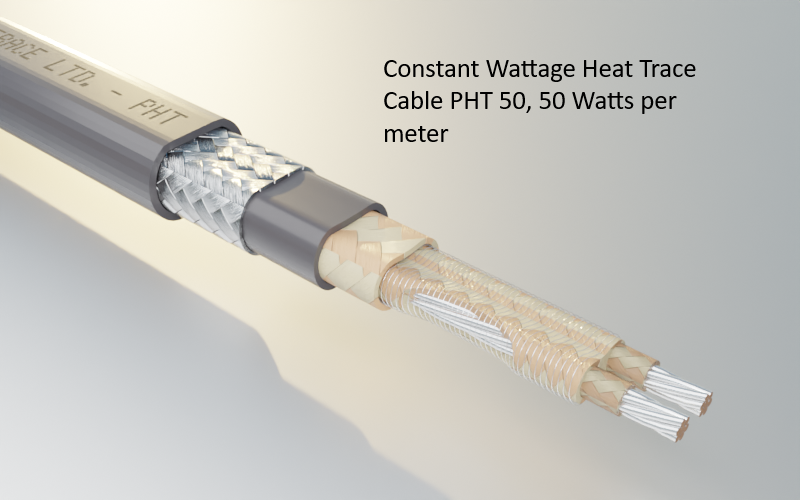
The following application checklist provides a practical guide for selecting PowerHeat PHT 50W/m Constant Wattage Heat Trace Cable for maintaining bitumen at 180°C in insulated pipelines operating in Australian conditions with a minimum ambient temperature of 0°C.
Application Checklist
| Application Checklist | Pipe Diameter 25NB | Pipe Diameter 50NB | Pipe Diameter 75NB | Pipe Diameter 100NB |
|---|---|---|---|---|
| Maintain Temperature of Bitumen (°C) | 180 | 180 | 180 | 180 |
| Minimum Ambient Temperature (°C) | 0 | 0 | 0 | 0 |
| Heat-up Time (°C/Hour) | N/A | N/A | N/A | N/A |
| Recommended Insulation Thickness (mm) | 40 | 50 | 63 | 75 |
| Allowance for Flange (m) | 0.3 | 0.3 | 0.3 | 0.6 |
| Allowance for Pipe Support (m) | 0.3 | 0.3 | 0.3 | 0.6 |
| Allowance for Valve (m) | 0.3 | 0.9 | 0.9 | 1.2 |
| Allowance for Pump (m) | 0.3 | 0.9 | 0.9 | 1.2 |
| Allowance for Termination (m) | 1 | 1 | 1 | 1 |
| Calculated Heat Loss (W/m) | 74 | 88 | 98 | 102 |
| Recommended Heat Trace Cable | PHT 50W/m | PHT 50W/m | PHT 50W/m | PHT 50W/m |
| Ratio of Cable to Pipe | 1.5 : 1 | 1.75 : 1 | 2 : 1 | 2 : 1 |
| Maximum Heat Trace Cable Length (m) | 68 | 68 | 68 | 68 |
| Equivalent Pipe Length per Circuit (m) | 45 | 39 | 34 | 34 |
Understanding the Results
The heat loss values demonstrate why larger diameter pipelines require a greater cable-to-pipe ratio. While the PHT 50W/m Constant Wattage Cable remains suitable across all pipe sizes shown, the cable installation density increases as pipe diameter and heat loss increase.
For example:
Pipe diameter of 75NB, 10 metre pipe length with 2 flanges, 2 pipe supports, 1 valve and 1 pump. The total length of PHT 50 heat trace cable required is:
(10 + 2 flanges × 0.3 + 2 pipe supports × 0.3 + 1 valve × 0.9 + 1 pump × 0.9) × ratio of 2 : 1 + 1 m for termination = 27 m
These calculations assume:
- Bitumen maintenance temperature of 180°C
- Minimum ambient temperature of 0°C
- Quality thermal insulation installed to the specified thickness
- Continuous temperature maintenance rather than product heat-up
Typical Cable Installation Methods
For bitumen service, PHT cable is typically installed using:
- Straight tracing on smaller pipe diameters
- Multiple parallel runs
- Spiral wrapping on larger pipes
- Additional tracing around valves, pumps and flanges to compensate for increased heat losses
Special attention should always be given to pumps, valves and supports, as these components generally create localized heat sinks and require additional heating cable allowances.