
Information & News
Why Heating Elements Fail Prematurely and How Australian Manufacturer like Backer Cynebar Ohmic Can Double Their Service Life
by JN ·
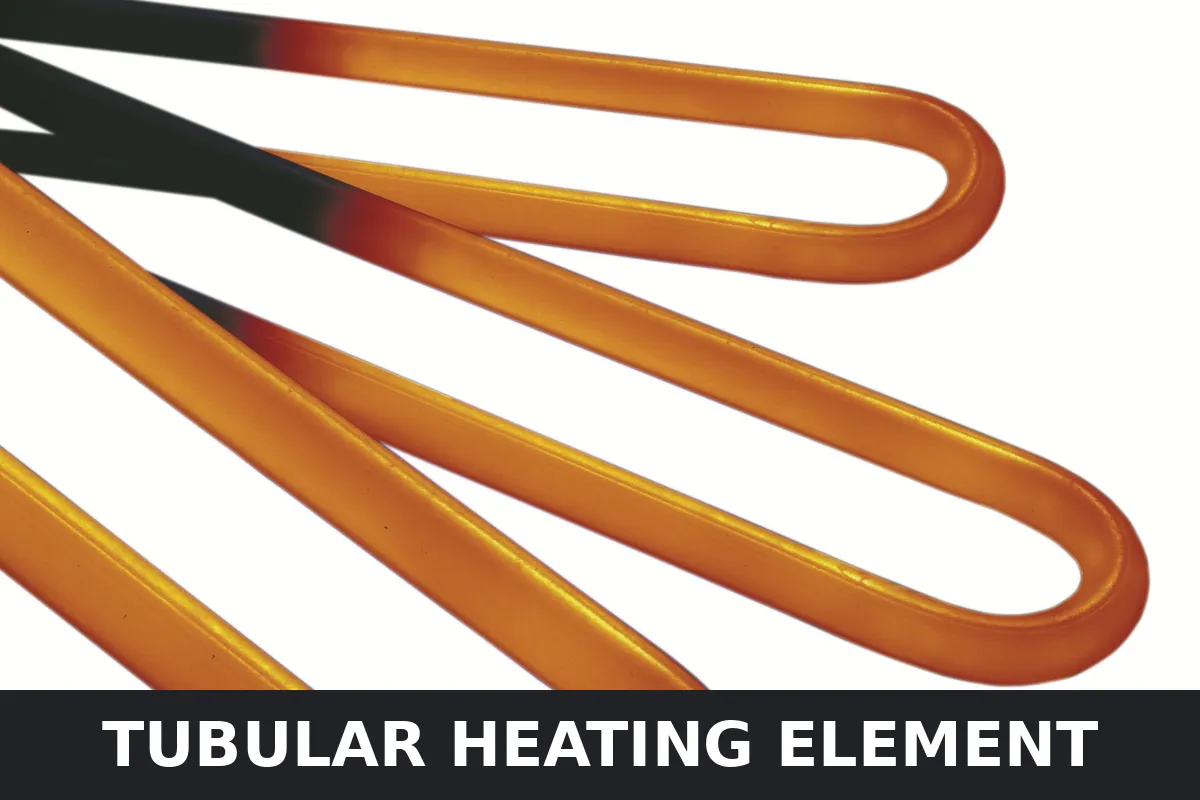
Across Australia, heating elements work hard in some of the country's toughest industrial environments. From mine sites in Western Australia and water treatment plants in regional Queensland to food manufacturers in Victoria and processing facilities across New South Wales, electric heaters are often a critical part of production.
Yet many businesses still treat heating elements as disposable components. When a heater fails, it's replaced and operations move on.
The reality is that most premature heating element failures have an identifiable cause. Understanding and addressing these causes can significantly reduce downtime, lower maintenance costs and improve plant reliability.
Not All Heating Element Failures Are Normal
While every heating element will eventually wear out, repeated failures within months rather than years are usually a sign that something is wrong.
Common warning signs include:
- Frequent element replacements
- Unexpected shutdowns
- Burnt-out heaters
- Reduced heating performance
- High maintenance costs
- Inconsistent process temperatures
In many cases, the heating element isn't the real problem. It's simply the first component showing that something else in the system needs attention.
1. Number one culprit, excessive Watts Density
One of the most common causes of premature heater failure is excessive watt density.
Simply put, watt density is the amount of power generated across the surface area of a heating element. Often referred to as Watt/cm², kW/m² or Watt/inch².
Worked example: a straight heating element
- Power: 1 kW (1,000 W)
- Heated length: 100 cm
- Diameter: 8 mm (0.8 cm)
Watt density = Power ÷ (π × diameter × heated length)
Watt density = 1,000 W ÷ (π × 0.8 cm × 100 cm) ≈ 3.98 W/cm²
π (pi) ≈ 3.142.
If too much heat is concentrated into a small area, element temperatures rise beyond their ideal operating range.
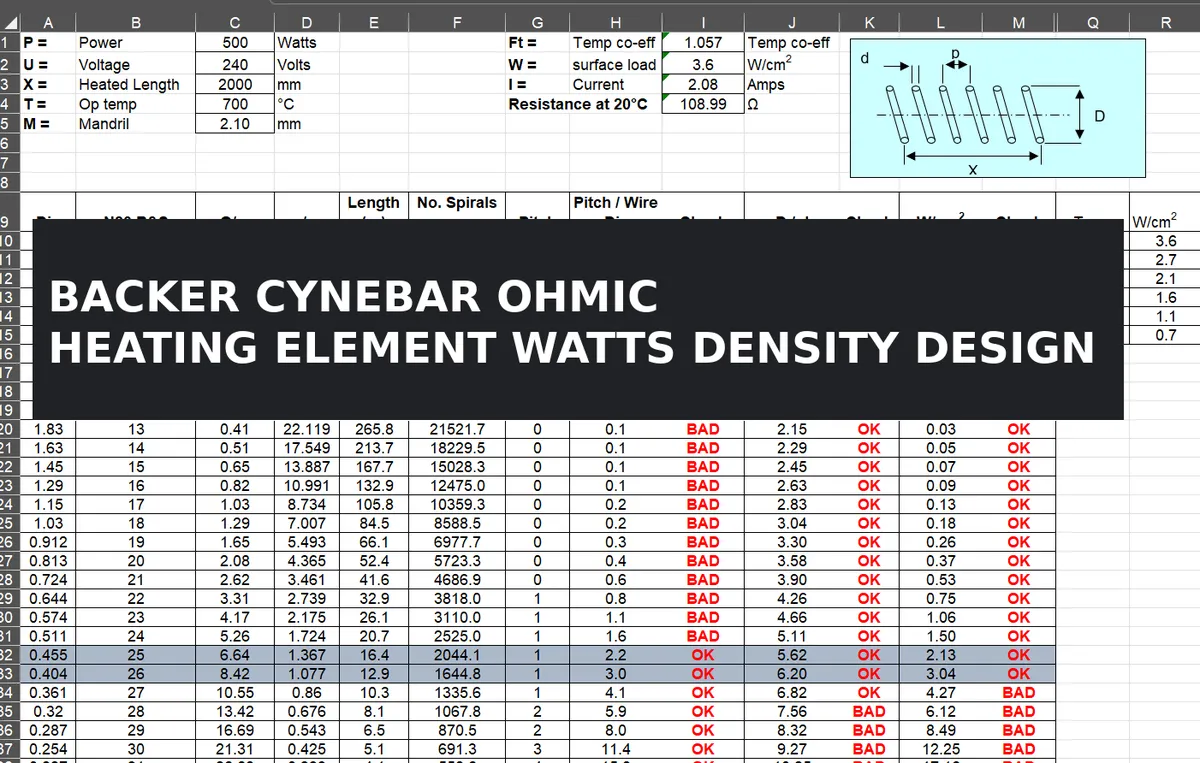
At Backer Cynebar Ohmic, we look beyond surface watt density to the nichrome resistance wire inside the heating element. By considering a 240 V design rather than 415 V and adjusting the wattage up or down, we can select a suitable wire gauge for the application. A larger-diameter nichrome wire operating at a lower watt density can make a significant difference.
This can cause:
- Premature oxidation
- Internal hot spots
- Insulation breakdown
- Reduced service life
Australian Example
Many facilities use heating elements in tanks containing heavy oils, grease traps or wastewater. A heater selected for clean water may fail quickly when installed in these more demanding applications because the watt density is too high.
Choosing the correct watt density for the specific process can often double the operational life of a heating element.
2. Scale Build-Up from Hard Water
Hard water is one of the biggest challenges faced by industrial heating systems throughout Australia.
Water sourced from bores, regional town supplies and mining operations often contains high levels of calcium and minerals. These minerals gradually build up on heating elements.
The result?
The element must work harder to transfer heat through the scale layer.
Over time this can lead to:
- Higher operating temperatures
- Increased energy consumption
- Reduced heating performance
- Premature failure
Industries Most Affected
- Water treatment
- Food processing
- Agriculture
- Mining camps
- Commercial hot water systems
A regular cleaning and inspection program can dramatically extend heater life while also improving energy efficiency.
3. Selecting the Wrong Material
Not all heating elements are created equal.
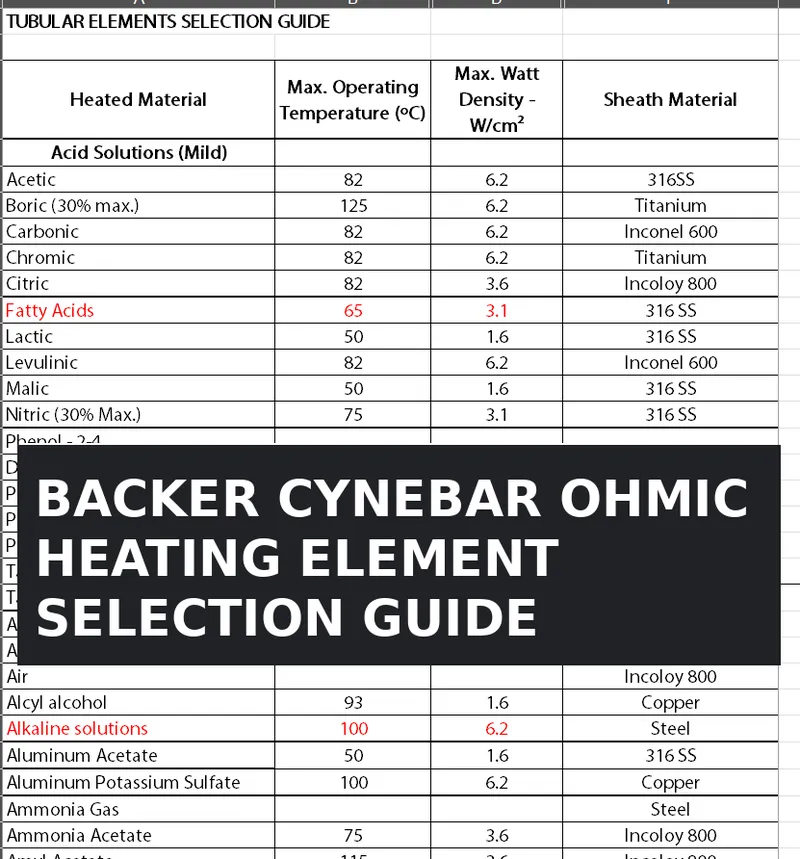
3.1 Heating Element Sheath Material
A heater that performs perfectly in an indoor manufacturing plant may fail rapidly in a corrosive coastal environment or chemical process.
Common industrial materials include:
| Material | Typical Application |
|---|---|
| Stainless Steel 304 | General manufacturing |
| Stainless Steel 316 | Marine and corrosive environments |
| Incoloy 800 | High-temperature process heating |
| Titanium | Aggressive chemical applications |
| Incoloy 825 | Corrosive chemical and high-end water heating |
3.2 Backer Cynebar Ohmic Only Uses High-Grade Magnesium Oxide (MgO)
Why Purity and Grain Size Matter
| Feature | Low-Grade MgO | High-Grade (Premium Electrical-Grade) MgO |
|---|---|---|
| Iron Content | Higher iron content (causes electrical short circuits at high temperatures) | Extremely low iron content (less than 0.1% to prevent electrical leakage) |
| Grain Distribution | Inconsistent grain distribution (creates air gaps and hot spots) | Optimised blending (achieves maximum compaction density) |
| Impact on Service Life | Leads to premature element burnout | Maximises element operating hours under heavy loads |
Australian Example
Many coastal facilities around Brisbane, Newcastle, Perth and Townsville experience accelerated corrosion when standard stainless-steel elements are installed instead of 316 stainless steel or a more suitable alloy.
Getting the material selection right from the beginning can save thousands of dollars in replacement costs.
4. Thermal Cycling
Industrial heating systems rarely operate under ideal conditions.
Many plants run multiple shifts, batch processes or intermittent production schedules. This causes heaters to continually heat up and cool down. This is where SSR's or SCR's can help extend the lifespan of the heating element. By switching rapidly SSR's and SCR's eliminate the expand and contract cycles that damage the magnesium oxide heat transfer rate, see our section on temperature control.
Over time, this repeated expansion and contraction can cause:
- Resistance wire fatigue
- Cracked insulation
- Terminal failures
- Reduced service life
Facilities that frequently start and stop production often experience this issue without realising it. Improving temperature control and reducing unnecessary cycling can have a significant impact on reliability.
5. Dry Firing
Dry firing occurs when an immersion heater is energised without being fully covered by liquid or the cold pin/inactive area should have been longer.
This is one of the most destructive conditions a heating element can experience.
Within minutes, temperatures can rise far beyond design limits, causing permanent damage.
Typical causes include:
- Low tank levels
- Failed level switches
- Pump faults
- Operator error
- Poor commissioning procedures
A Costly Mistake
We've seen situations where a simple failed level sensor has resulted in thousands of dollars in heater replacements and lost production.
Protecting heaters with low-level controls is often one of the best returns on investment available.
6. Temperature Control Problems
Heating elements regularly get blamed for failures that actually originate in the control system.
Faulty or poorly configured:
- Temperature controllers
- Thermocouples
- RTDs
- Contactors
- Solid-state relays
- Overtemperature backup
can cause heaters to operate at unnecessarily high temperatures.
In these situations, replacing the heater without investigating the control system usually results in the same failure occurring again.
A heater and control system should always be viewed as a complete package.
7. Vibration and Harsh Operating Conditions
Australian industry is not always gentle on equipment.
Mining operations, quarrying, mobile plant and heavy manufacturing can expose heating systems to intense vibration and mechanical stress.
These conditions can lead to:
- Loose terminals
- Cracked sheaths
- Internal wire damage
- Electrical faults
In harsh environments, a standard commercial heater may not be suitable.
Purpose-designed industrial heating solutions are often required to achieve acceptable service life.
A Simple Heater Failure Checklist
Before replacing a failed heater, ask:
- ✅ Has the process changed?
- ✅ Is the watt density suitable?
- ✅ Is scale building up on the element?
- ✅ Is the sheath material appropriate?
- ✅ Has dry firing occurred?
- ✅ Have the controls been checked?
- ✅ Are vibration or environmental conditions contributing to the problem?
Asking these questions often uncovers the root cause before another heater is installed.
How to Significantly Extend Heating Element Life
The longest-performing industrial heating systems generally share five characteristics:
- Correct watt density selection
- Appropriate sheath materials
- Reliable temperature control
- Routine inspection and cleaning
- Protection against dry firing
When these factors are addressed, many Australian facilities achieve years of reliable service while reducing maintenance expenditure and unplanned downtime.
Work With an Engineering Partner, Not Just a Heater Supplier
At Backer Cynebar Ohmic, we help customers do more than replace failed heating elements.
As part of the global Backer Group, we combine local Australian manufacturing and engineering support with decades of international process heating expertise.
Whether you're operating a mine site in the Pilbara, a food processing facility in Victoria, a water treatment plant in Queensland or an industrial manufacturing operation anywhere across Australia, understanding why a heater failed is often the key to improving reliability and reducing operating costs.
Need Help Troubleshooting a Heater Failure?
Our engineering team can assess failed heating elements, identify root causes and recommend practical solutions to improve service life, efficiency and plant reliability.
Stop replacing heaters. Start solving the problem behind the failure.