Information & News
The True Cost of Imported NERs: Lead Times, AS/NZS Compliance and Local Support
by JN ·
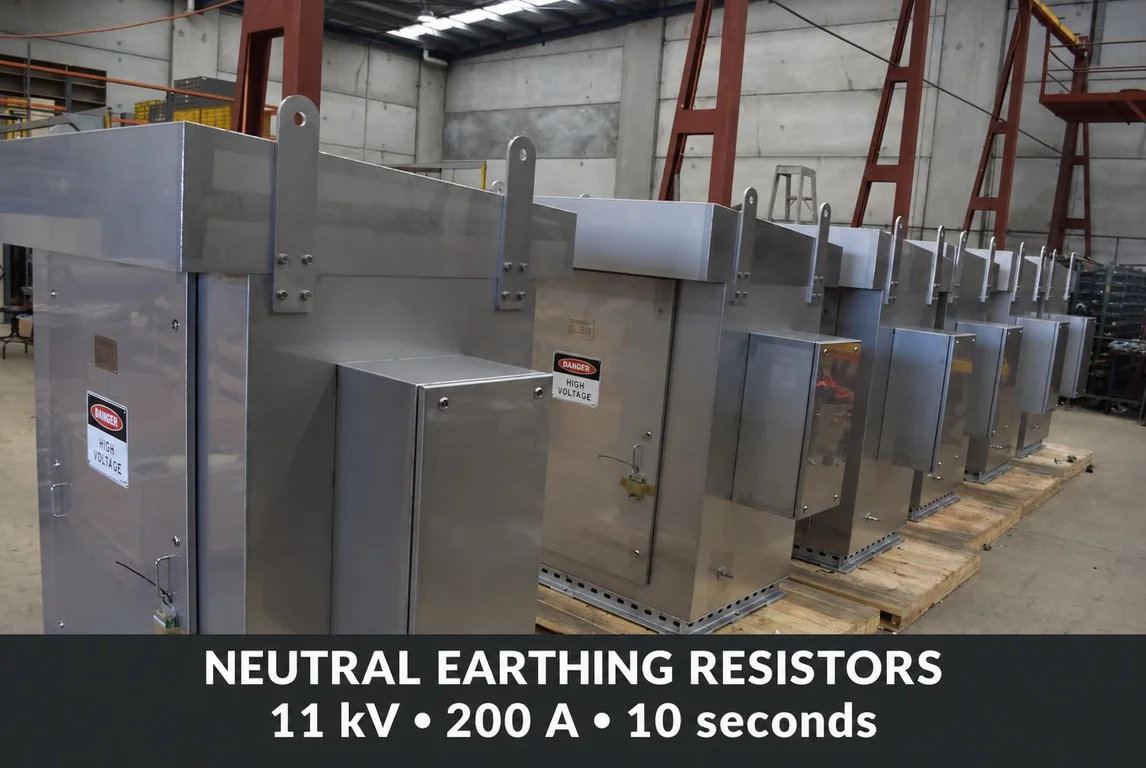
Why the cheapest Neutral Earthing Resistor quote is rarely the cheapest NER by the time it is energised.
A Neutral Earthing Resistor (NER) is a small line item on a large project. It sits between the neutral point of a transformer or generator and the earth grid, limiting earth fault current so protection can detect and clear a fault without destroying the equipment around it. Because it looks like a simple steel enclosure, it is often treated as a commodity, and the lowest quote wins.
But an NER is also a safety-critical protection device. It has to be rated correctly for the system voltage, fault current and fault duration, built for the site's environment, and documented in a way your consultant, utility or mine can accept. When an imported unit arrives late, arrives without the right paperwork, or needs a change after it lands, the real cost shows up in the project schedule, not the purchase order. Here is what we see engineers and procurement teams run into, and why sourcing an Australian-made NER changes the equation.
1. Lead times: the delay is bigger than the shipping time
Ocean freight is the part of an imported lead time that everyone budgets for. The parts that catch projects out are the ones around it: drawing approvals that cross time zones, a design query that takes days to answer, customs and quarantine clearance, and delivery to site at the end. Every time a drawing comment or specification change goes back overseas, the clock restarts.
Our engineering, fabrication and testing all happen in one Brisbane facility at Richlands. Your engineer can speak to the person who designed the resistor, a revision to the enclosure or earthing configuration is a phone call away, and the finished unit travels domestically rather than across an ocean. For turnaround and shutdown work in particular, where an outage window is fixed and a late delivery means a missed restart, that proximity matters. It is also a real advantage for projects in the eastern states, where a local NER supplier is closer to site than an interstate or overseas one.
2. Compliance: designed for Australian conditions and Australian paperwork
NERs live inside a framework of Australian standards and regulation. AS/NZS 3000 (the Wiring Rules) governs earthing arrangements for Australian installations, and AS 2067 sets the minimum requirements for substations and high voltage installations above 1 kV a.c. Utilities, mines and consultants also bring their own site and network specifications on top. An NER that was designed to a generic overseas specification can leave your team spending weeks on clarifications, deviations and re-submissions.
Imported electrical equipment can also bring its own regulatory obligations, including registration and conformity requirements under Australia's Electrical Equipment Safety System where the equipment is in scope. Whoever is responsible for the equipment in Australia needs to be able to show a valid compliance chain, and chasing that evidence from an overseas factory after the order is placed is a poor use of everyone's time.
Environmental design is the other half of compliance with reality. Australian sites routinely see ambient design temperatures around 45–50°C, and direct sun can push internal enclosure temperatures well beyond the nominal ambient figure. That is why we ask whether an installation is indoor, outdoor, coastal, mining or industrial processing, and why we offer options such as sunshields, 304 or 316 stainless steel enclosures, and designs suited to tropical and cyclonic locations. These details are far easier to get right with a local team that understands the conditions the NER will actually face.
3. Local support: what happens after the delivery docket
An NER is meant to sit quietly for years and then perform on the one day it is needed. Support over that life is part of the cost. With an imported unit, a question about terminations, a missing auxiliary item or a site change can mean emails across time zones and a wait for answers. With a local manufacturer, you get a direct line to engineers who know the design, can look at the unit's configuration, and can help with auxiliary items such as neutral current transformers, isolating switches and enclosure heaters.
Our designs cover systems from 240 V to 33 kV and currents from 2 A to 2,000 A, with indoor and outdoor enclosures and fault-duration ratings tailored to your protection scheme. Every unit is designed, built and tested here in Brisbane, by an ISO 9001 certified company.
4. Resistor specialists, not a catalogue add-on
Backer Cynebar Ohmic brings together long-established Australian resistor expertise. Ohmic Resistors, a specialist designer and manufacturer of neutral earthing and dynamic braking resistors, moved its manufacturing from Sydney to Brisbane to share resources with Cynebar, alongside the STANDARD RESISTOR™ brand, which is used across Australia and overseas for dynamic braking, motor starter and neutral earthing applications. The result is a team that lives and breathes resistor design: alloy steel grid elements, enclosure engineering, and the testing that proves a unit will perform when a fault occurs.
That focus shows in how we work. Resistors are what we design, build and test every day, so you are talking to specialists rather than a general electrical supplier with a resistor page in the catalogue.
Getting an accurate NER quote the first time
One of the most common causes of delay on any NER order is an incomplete quote request. Whoever you buy from, have these details ready:
- System voltage: typically 3.3, 6.6, 11, 22 or 33 kV (the resistor is sized on phase-to-neutral voltage).
- Maximum earth fault current: the value that satisfies both equipment protection and relay coordination.
- Fault duration: a 10-second rating is widely used, but your protection scheme sets the requirement.
- Continuous current: if the NER must carry current continuously, say so at quotation stage.
- Installation environment: indoor, outdoor, coastal, mining or industrial processing, plus the required IP rating.
- Enclosure material and finish: for example 304 or 316 stainless steel, or a specified RAL colour.
- Auxiliary items: current transformers, isolating switches, enclosure heaters and sunshields.
The bottom line
An NER quote should be compared on the full picture: lead time from order to energisation, how well the design suits your standards and site conditions, and who will answer the phone when something changes. Weighed that way, an Australian-made NER from a dedicated resistor manufacturer often turns out to be the lower-risk and lower-cost choice.
Planning an NER for your next project or shutdown? Tell our Brisbane engineers about your application and we will help you specify the right solution. Visit our Neutral Earthing Resistor page, call +61 (07) 3252 4257 or email sales@backercynebarohmic.com.au.